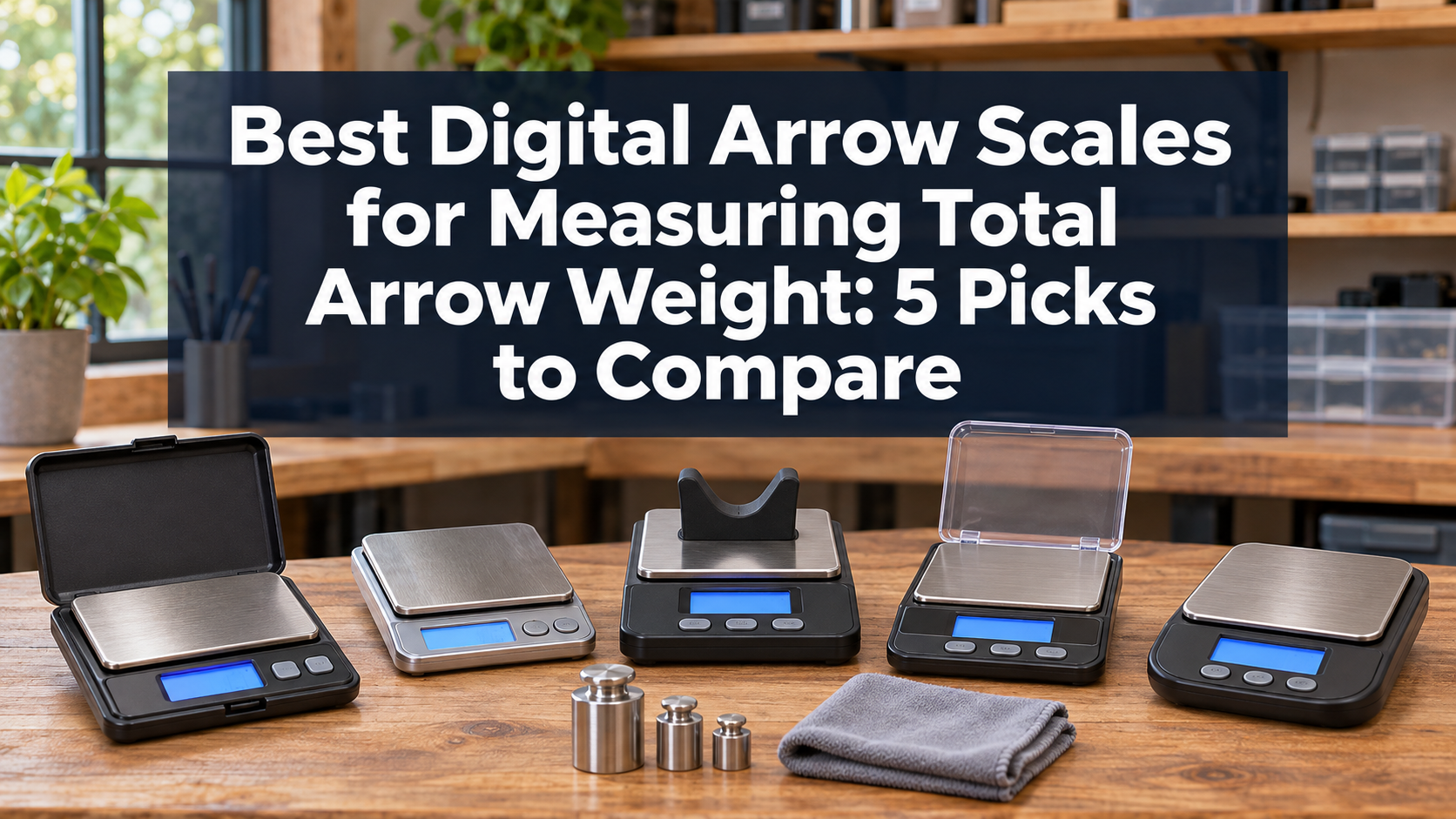
A digital arrow scale helps you record the weight of a completed build rather than estimate it from a shaft label. That can be useful when comparing arrows, changing components, or keeping records for future replacements.
The buying decision involves more than finding a display that shows grains. You also need sufficient capacity, suitable support for a long arrow, clear calibration instructions, and performance information that covers the weights you intend to measure.
This guide compares five products using published manufacturer or brand-seller information. It is not a hands-on accuracy ranking.
Two selections are marketed for archery. Three are compact scales marketed for other weighing tasks and require confirmation of a suitable arrow-support arrangement.
Amazon shopping note: Links open Amazon.com searches rather than verified in-stock listings. Confirm the exact model, seller, accessories, delivery availability, and return policy. Specialist archery models may be easier to obtain directly from an authorized archery dealer.
Five Products at a Glance
Table of Contents
| Product | Published capacity | Main purchase check |
|---|---|---|
| Last Chance Archery Pro Grain Scale 2.0 | 200g | Grain-mode specification and calibration weight |
| X-Spot Digital Scale | 771 grains | Long-arrow support and included accessories |
| Frankford Arsenal DS-750 | Advertised as 750 grains | Capacity margin for arrow plus holder |
| Hornady G3-1500 | 1,500-grain maximum reference measurement | Stated 0.1-grain accuracy applies up to 500 grains |
| Lyman Pocket-Touch 1500 | 1,500 grains | Appropriate holder and current grain-mode performance |
Capacities are published figures, not verified test results. A support accessory still uses capacity even when its weight is tared from the display.
1. Last Chance Archery Pro Grain Scale 2.0
 An archery-focused option with an included arrow holder
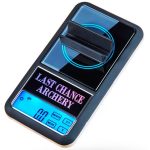 An archery-focused option with an included arrow holder
Last Chance Archery lists a 200g capacity and multiple units, including grains, for the Pro Grain Scale 2.0. Its package includes a rubber arrow holder and two AAA batteries.
The product also includes an F.O.C. cradle, but total weight and front-of-center balance are different measurements.
The holder makes this a practical starting point for complete-arrow weighing. Check that your finished arrow remains clear of the lid, scale body, and bench.
The manufacturer’s stated 0.01g figure should not be read as 0.01 grain. Ask for the grain-mode display increment and applicable accuracy specification if you need to distinguish small differences.
Why compare it: Included arrow support and archery-focused features.
What to check: Grain-mode performance, holder clearance, and calibration equipment. The manufacturer specifies a 200g calibration weight for calibration mode; confirm whether it is included.
Amazon.com : Archery Pro Grain Scale 2.0 : Sports & Outdoors
2. X-Spot Digital Scale
A compact scale marketed for arrows and components
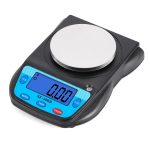 A compact scale marketed for arrows and components
Lancaster Archery’s X-Spot listing describes a scale for arrows, points, and nocks. It lists a 771-grain maximum, 0.1-grain display increments, and a separate stated accuracy of 0.15 grain.
The published package includes a protective case and two AAA batteries. Lancaster Archery Supply
Those separate figures are helpful: the smallest displayed step and the claimed accuracy are not identical.
Before buying, confirm how a full-length arrow is supported. Do not assume that a case or accessory in a photograph is a suitable weighing cradle.
Its capacity also deserves attention if your intended builds or support accessories approach the limit.
Why compare it: An archery-marketed pocket scale with separately stated display and accuracy figures.
What to check: Arrow support, calibration procedure, package contents, and capacity margin.
3. Frankford Arsenal DS-750 Digital Scale
A pocket option when the complete load fits its range
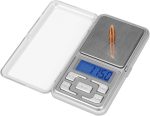 Frankford Arsenal lists grain, gram, ounce, and carat modes for the DS-750. Its product page advertises a 750-grain capacity and includes a pan, carry bag, and calibration weight.
This model is marketed for reloading measurements, rather than specifically for arrows. Confirm a suitable holder before treating it as a complete-arrow weighing solution.
The manufacturer pairs 750 grains with 50g and 0.1-grain accuracy with 0.01g in its specifications. Those unit values are not exact equivalents, so obtain clarification if the difference matters near your required limits.
Compare the supported load and required measurement performance, not only the product name.
Why compare it: Multiple units and an included calibration weight.
What to check: Clarified specifications, arrow-holder suitability, and the total physical load.
4. Hornady G3-1500 Digital Pocket Scale
A model whose accuracy range needs particular attention
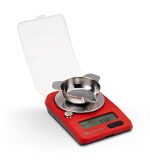 A model whose accuracy range needs particular attention
Hornady’s instructions state 0.1-grain accuracy up to 500 grains, with a maximum reference measurement of 1,500 grains. The manual also lists grain and gram modes and operation on two AAA batteries, which it says are not included.
That distinction is important when weighing finished arrows. A 1,500-grain maximum does not establish the same accuracy throughout the entire range.
If your completed arrow exceeds 500 grains, obtain the applicable performance specification before choosing this model for close comparisons.
Also confirm the support arrangement. A small weighing plate does not by itself provide secure support for a long arrow.
Why compare it: A manufacturer manual that distinguishes its accuracy range from its maximum reference measurement.
What to check: Intended arrow weight, permitted loading arrangement, batteries, and calibration accessories.
5. Lyman Pocket-Touch 1500 Digital Scale Set
A compact alternative with a calibration accessory
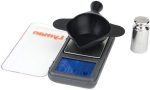 A compact alternative with a calibration accessory
Lyman lists a 1,500-grain capacity for the Pocket-Touch 1500, with touchscreen controls, a lighted display, and automatic shutoff. The package includes a calibration weight, pan, scoop, and two AAA batteries.
Its instructions identify separate grain and gram modes.
This is another scale marketed for reloading, so compare it as a conditional option for arrow weighing rather than a ready-made archery package.
Check the current grain-mode resolution, stated accuracy, and support options. Confirm the model number, because Pocket-Touch and other similarly named Lyman scales are different products.
Why compare it: Compact storage and an included calibration weight.
What to check: Exact model, current specifications, arrow support, and shutoff behaviour.
How to Choose a Digital Arrow Scale
Separate Finished Weight From Shaft GPI
 Grains per inch, or GPI, describes shaft weight per unit of length. Easton explains that its listed GPI excludes the point, nock, insert, and fletching.
For total arrow weight, weigh the completed configuration you intend to use. Include installed components and record the configuration alongside the reading.
A shaft calculation can help estimate a build, but it should not be presented as a measured finished weight. Changes to points, nocks, wraps, or other components can change the completed total.
Confirm Grains Rather Than Grams
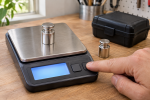 Check the unit shown on the display before recording a reading. “g” indicates grams; these manuals commonly use “gn” for grains.
NIST lists one grain as exactly 64.79891 milligrams. Therefore, one gram is approximately 15.432 grains, and 0.01g is approximately 0.154 grain.
For example, 30g is approximately 463 grains. Confusing the units would create a major recording error.
Do not convert a gram-mode display increment into a claim about accuracy. Conversion changes units, not instrument performance.
Distinguish Resolution, Accuracy, and Repeatability
 Resolution is the smallest displayed step. Accuracy concerns how closely a reading corresponds to the actual value under specified conditions. Repeatability concerns how closely repeated measurements agree.
A display showing tenths of a grain does not automatically establish accuracy to a tenth of a grain.
Ask for specifications in the unit and range you will use. If you are trying to separate arrows by a small difference, the scale’s documented performance must be suitable for that task.
Include the Holder in Capacity Planning
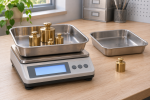 A holder can keep a long arrow from rolling or touching surrounding surfaces, but it remains part of the physical load.
Taring the holder removes its displayed contribution; it does not increase the scale’s maximum capacity.
For example, a holder weighing 100 grains and an arrow weighing 650 grains create a 750-grain load. That leaves no capacity margin on a scale rated to 750 grains.
Confirm how the manufacturer specifies capacity and any limits that apply to accessories or off-centre loading.
Keep the Whole Arrow Clear
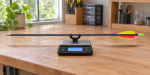 The arrow’s weight must be carried through the weighing platform. Contact with the bench, scale housing, lid, or another support can affect the reading.
Choose a suitable holder that sits entirely on the weighing surface and provides clearance for the nock, fletching, and point.
Do not assume every third-party cradle fits every pocket scale. Confirm platform dimensions, holder stability, and the manufacturer’s permitted loading arrangement.
Read Calibration and Setup Instructions
 Check the required calibration weight, whether it is included, and when the manufacturer recommends calibration or verification.
Follow the model’s warm-up and setup instructions. Hornady, for example, specifies a stable, level surface and warns that temperature changes, airflow, and nearby electronic equipment can affect its readings. static.hornady.media
Calibration and taring are different operations. A zero reading alone does not verify performance across the weighing range.
Record Results Consistently
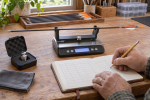 Assign each arrow an identifier and record its completed weight, unit, components, and measurement date.
Check that readings settle and that repeated placements give consistent results. If they vary, investigate the setup before using the figures to sort arrows.
Retain useful notes about the scale, holder, and measurement method. Consistent records make later comparisons more meaningful than isolated numbers without context.
Does Arrow Weight Establish Compatibility or Safety?
 No. Weight is one specification within the complete bow-and-arrow setup.
Follow your bow manufacturer’s arrow-weight requirements alongside the arrow manufacturer’s selection and inspection guidance. A suitable weight reading does not establish correct spine, length, component fit, or freedom from damage.
For the most convenient starting point, compare the Last Chance model’s included holder with the X-Spot’s support requirements. Consider the other pocket scales only after confirming suitable support, capacity, and performance for your finished arrows.